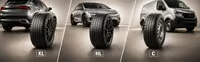
What are Run Flat Tyres (RFT)?
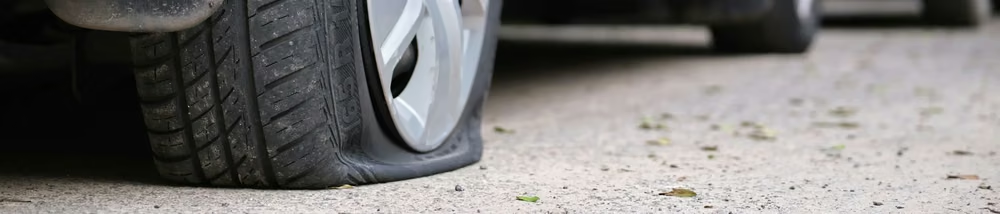
Run Flat Tyres (RFT) have reinforced sidewalls that allow you to continue driving up to 80 km at 50 mph even after a complete puncture, giving you time to reach a service center safely.
What is Run Flat Technology?
Run Flat Tyres (RFT) are specially designed tyres with reinforced sidewalls that allow you to continue driving even after a puncture. Unlike regular tyres that go completely flat, RFT tyres maintain their shape and can support the vehicle weight without air pressure.

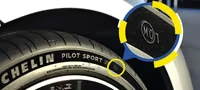
Sidewall marking
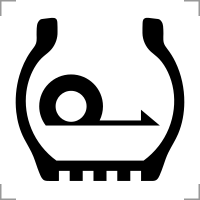
Dashboard warning
How do Run Flat Tyres work?
Run Flat tyres use reinforced sidewalls made from heat-resistant rubber compounds. These sidewalls are significantly thicker and stiffer than standard tyres, allowing them to support the vehicle even when air pressure is lost.
Different manufacturer markings
Each tyre manufacturer uses different codes for Run Flat technology:
Distance and speed limits
After a puncture, Run Flat tyres allow you to drive:
- Up to 80 km (50 miles) distance
- Maximum 80 km/h (50 mph) speed
Important warnings
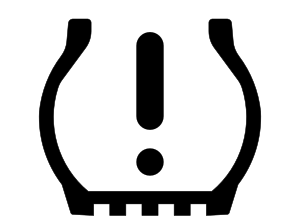
TPMS Required: Run Flat tyres can ONLY be used on vehicles equipped with a Tyre Pressure Monitoring System (TPMS). Without TPMS, you might not notice a puncture. This symbol appears on your dashboard when tyre pressure is low.
Never mix: Self-supporting run-flat tyres must never be mixed with standard tyres on any vehicle.
Retrofitting not recommended: All major tyre manufacturers recommend against fitting run-flat tyres to vehicles not originally designed for them.
Advantages
- No need to change tyres in dangerous conditions
- Better stability during a blowout
- No spare tyre needed - more trunk space
Disadvantages
- Stiffer ride quality
- Higher price than regular tyres
- Cannot be repaired after driving flat
Recommended tyres
Find run-flat tyres
Choose your tyre size to see matching products.
Recommended tyres — size examples
Examples from this selection. Choose your size to see matching tyres.
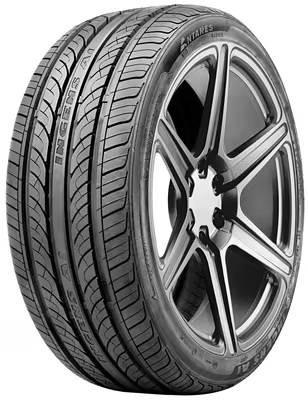
ANTARES
INGENS A1
195/55 R16 87V
Production date: 2025 - 2026
RP
RP (Rim Protector)
RP (Rim Protector) — generic rim-guard marking.
RFT
RFT (Run Flat)
Run-Flat — reinforced sidewalls allow driving up to 80 km (at up to 80 km/h) after a puncture.
Read more →
E
Fuel efficiency (A–E)
Rolling resistance class A (best) to E. Difference between classes — up to 9% in fuel consumption.
C
Wet grip (A–E)
Wet braking distance. Class A — shortest, E — longest. The difference can reach 30%.
B|70dB
Noise level (dB)
External rolling noise in decibels. Lower number means quieter tire.
 RFT (Run Flat)
Run-Flat — reinforced sidewalls allow driving up to 80 km (at up to 80 km/h) after a puncture.
Read more →
M+S
M+S (Mud & Snow)
M+S (Mud & Snow) — for light snow and mud. Not certified; weaker than 3PMSF.
Read more →
RFT (Run Flat)
Run-Flat — reinforced sidewalls allow driving up to 80 km (at up to 80 km/h) after a puncture.
Read more →
M+S
M+S (Mud & Snow)
M+S (Mud & Snow) — for light snow and mud. Not certified; weaker than 3PMSF.
Read more →
Delivery:
October 28 - November 3
Only 11 units are currently in stock. The maximum available quantity is 11.
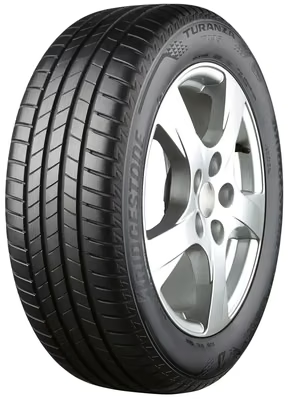
BRIDGESTONE
Turanza T005
275/35 R19 100Y
Production date: 2025 - 2026
XL
XL (Extra Load)
XL (Extra Load) — reinforced for ~11% higher load than standard.
Read more →
*
Homologation (OE)
Manufacturer homologation — tire specifically approved by the vehicle manufacturer.
Read more →
RP
RP (Rim Protector)
RP (Rim Protector) — generic rim-guard marking.
RFT
RFT (Run Flat)
Run-Flat — reinforced sidewalls allow driving up to 80 km (at up to 80 km/h) after a puncture.
Read more →
B
Fuel efficiency (A–E)
Rolling resistance class A (best) to E. Difference between classes — up to 9% in fuel consumption.
B
Wet grip (A–E)
Wet braking distance. Class A — shortest, E — longest. The difference can reach 30%.
B|71dB
Noise level (dB)
External rolling noise in decibels. Lower number means quieter tire.
RFT (Run Flat)
Run-Flat — reinforced sidewalls allow driving up to 80 km (at up to 80 km/h) after a puncture.
Read more →
Delivery:
October 28 - November 3
Only 8 units are currently in stock. The maximum available quantity is 8.
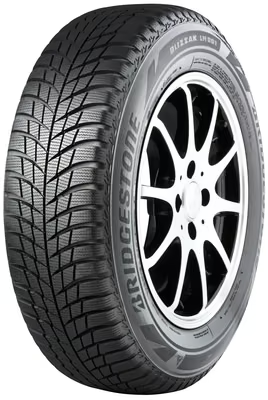
BRIDGESTONE
Blizzak LM001
245/50 R19 105V
Production date: 2025 - 2026
*
Homologation (OE)
Manufacturer homologation — tire specifically approved by the vehicle manufacturer.
Read more →
XL
XL (Extra Load)
XL (Extra Load) — reinforced for ~11% higher load than standard.
Read more →
RP
RP (Rim Protector)
RP (Rim Protector) — generic rim-guard marking.
RFT
RFT (Run Flat)
Run-Flat — reinforced sidewalls allow driving up to 80 km (at up to 80 km/h) after a puncture.
Read more →
C
Fuel efficiency (A–E)
Rolling resistance class A (best) to E. Difference between classes — up to 9% in fuel consumption.
B
Wet grip (A–E)
Wet braking distance. Class A — shortest, E — longest. The difference can reach 30%.
B|72dB
Noise level (dB)
External rolling noise in decibels. Lower number means quieter tire.
 3PMSF (Snow grip)
3PMSF — certified winter marking. Tire passed EU tests in deep snow.
Read more →
RFT (Run Flat)
Run-Flat — reinforced sidewalls allow driving up to 80 km (at up to 80 km/h) after a puncture.
Read more →
M+S
M+S (Mud & Snow)
M+S (Mud & Snow) — for light snow and mud. Not certified; weaker than 3PMSF.
Read more →
3PMSF (Snow grip)
3PMSF — certified winter marking. Tire passed EU tests in deep snow.
Read more →
RFT (Run Flat)
Run-Flat — reinforced sidewalls allow driving up to 80 km (at up to 80 km/h) after a puncture.
Read more →
M+S
M+S (Mud & Snow)
M+S (Mud & Snow) — for light snow and mud. Not certified; weaker than 3PMSF.
Read more →
Delivery:
October 28 - November 3
Only 27 units are currently in stock. The maximum available quantity is 27.
BRIDGESTONE
Blizzak LM001
245/50 R18 100H
Production date: 2024 - 2026
*
Homologation (OE)
Manufacturer homologation — tire specifically approved by the vehicle manufacturer.
Read more →
RFT
RFT (Run Flat)
Run-Flat — reinforced sidewalls allow driving up to 80 km (at up to 80 km/h) after a puncture.
Read more →
C
Fuel efficiency (A–E)
Rolling resistance class A (best) to E. Difference between classes — up to 9% in fuel consumption.
B
Wet grip (A–E)
Wet braking distance. Class A — shortest, E — longest. The difference can reach 30%.
B|72dB
Noise level (dB)
External rolling noise in decibels. Lower number means quieter tire.
3PMSF (Snow grip)
3PMSF — certified winter marking. Tire passed EU tests in deep snow.
Read more →
RFT (Run Flat)
Run-Flat — reinforced sidewalls allow driving up to 80 km (at up to 80 km/h) after a puncture.
Read more →
M+S
M+S (Mud & Snow)
M+S (Mud & Snow) — for light snow and mud. Not certified; weaker than 3PMSF.
Read more →
Delivery:
October 28 - November 3
Only 8 units are currently in stock. The maximum available quantity is 8.
View all tyres in this selection
→