

Tire markings explained
Below you will find all the main tire markings with explanations. Hover over a badge on the product card to see this explanation instantly, and click „Read more“ to go to the full article.
EU label
Fuel efficiency (A–E)
Rolling resistance class A (best) to E. Difference between classes — up to 9% in fuel consumption.
Wet grip (A–E)
Wet braking distance. Class A — shortest, E — longest. The difference can reach 30%.
Noise level (dB)
External rolling noise in decibels. Lower number means quieter tire.
Noise class (A–C)
EU noise class: A (quiet), B or C (loud).
Winter

3PMSF (Snow grip)
3PMSF — certified winter marking. Tire passed EU tests in deep snow.
Read moreM+S (Mud & Snow)
M+S (Mud & Snow) — for light snow and mud. Not certified; weaker than 3PMSF.
Read more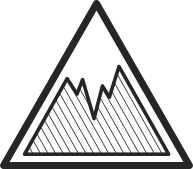
Ice grip
Certified ice grip (UN ECE R117): stops at least 18% shorter than a reference tire.

Studded
Studded tire for maximum grip on ice. Legal usage period varies by country.
Read moreP.O.R (Professional Off Road)
P.O.R (Professional Off Road) — off-road tire without an EU label. In Finland it is accepted as a winter tire.
Construction
R (Radial)
R (Radial) — modern standard since the 1970s. Body plies run perpendicular to travel direction.
Read moreB (Bias-belted)
B (Bias-belted) — diagonal plies with a stabilizing belt under the tread. Common on motorcycles.
Read moreD (Diagonal)
D (Diagonal) — older bias-ply construction with criss-crossed plies. Used on classic, agricultural and some motorcycle tires.
Read moreZR (Z-rated radial)
ZR — Z-rated radial. Legacy speed marking for tires rated above 240 km/h (V/W/Y).
Read moreCross-ply (–)
Cross-ply (no letter) — historic ISO notation for classic bias-ply tires, e.g. "80/90-21".
Read moreTechnology

RFT (Run Flat)
Run-Flat — reinforced sidewalls allow driving up to 80 km (at up to 80 km/h) after a puncture.
Read moreEV Ready
Optimized for EVs: higher load, lower rolling resistance, quieter cabin.
Silent
Internal polyurethane foam lining reduces cabin noise by up to 9 dB.
Load
XL (Extra Load)
XL (Extra Load) — reinforced for ~11% higher load than standard.
Read moreHL (High Load)
HL (High Load) — new 2021 standard. ~10% higher load than XL. For heavy EVs.
Read moreC (Commercial)
C (Commercial) — tire for vans, light trucks and commercial vehicles. Marked as "R16C" on the sidewall; typically higher load index and stiffer construction.
Read moreRim protection
FR (Fringe Rim)
FR — rubber ridge on sidewall protects the rim edge from curbs.
FP (Fringe Protector)
FP (Fringe Protector) — rim protection flange against scuffs.
MFS (Maximum Flange Shield)
MFS (Maximum Flange Shield) — Michelin extended rim protector for premium alloys.
RP (Rim Protector)
RP (Rim Protector) — generic rim-guard marking.
Sidewall style
BSW / BW / BLK (Black sidewall)
BSW / BW / BLK — black sidewall. No white letters or white stripe; the most common sidewall finish.
Read moreOWL (Outlined white letters)
OWL — outlined white letters. The letter edges are white, often used on SUV and 4x4 tires.
Read moreRWL (Raised white letters)
RWL — raised white letters. Larger raised white lettering on the tire sidewall.
Read moreORWL / ROWL (Outlined raised white letters)
ORWL / ROWL — outlined raised white letters. A mixed style between OWL and RWL.
Read moreWSW / WW / WSE (White sidewall)
WSW / WW / WSE — white sidewall or white stripe. Common on classic and retro tires.
Read moreRBL / SBL / BSL / VSB (Black letters)
RBL / SBL / BSL / VSB — black raised or serrated sidewall letters. Cosmetic style, not a performance rating.
Read moreRVL (verify code)
RVL — not a standard sidewall code in major catalogs. Verify whether it means RWL or an internal supplier code.
Read moreHomologation
Homologation (OE)
Manufacturer homologation — tire specifically approved by the vehicle manufacturer.
Read moreMO (Mercedes-Benz)
MO — Mercedes-Benz original equipment homologation.
Read moreAO (Audi)
AO — Audi original equipment homologation.
Read moreN0/N1/N2 (Porsche)
N0/N1/N2 — Porsche homologation (number indicates iteration).
Read more★ (BMW)
★ — BMW / MINI homologation.
Read more