

Studded Tyres
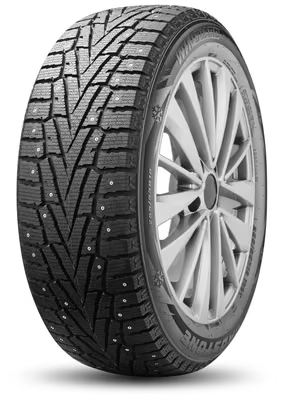
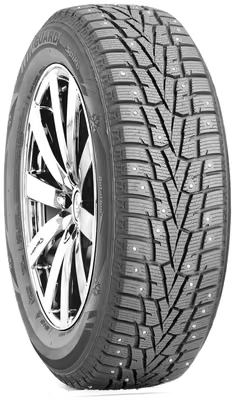
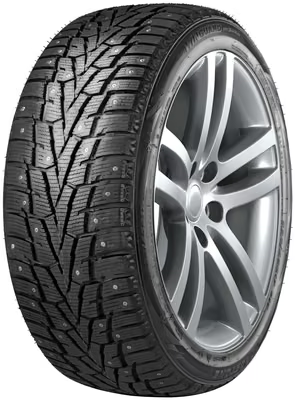
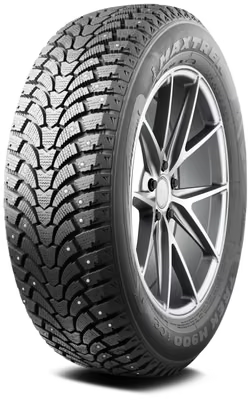
Studded tyres give the best grip on ice and packed snow and suit drivers who travel in the countryside, on unmaintained roads or early in the morning. In Estonia they may be used from 15 October to 31 March, or from 1 October to 30 April in wintry conditions, and must be fitted on all wheels.
1524 matching results


 M+S
M+S

 M+S
M+S
M+S
M+S
 M+S
M+S
M+S
M+S
M+S
M+S
M+S
M+S
M+S
M+S
M+S
M+S
M+S
M+S
 M+S
M+S
 M+S
M+S
M+S
M+S
M+S
M+S
M+S
M+S
M+S
M+S
M+S
M+S
M+S
M+S
M+S
M+S
M+S
M+S
M+S
M+S
M+S
M+S
M+S
M+S
M+S
M+S
24 from 1524 products displayed
When studded tyres are allowed
Studded tyres may be used from 15 October to 31 March. If wintry road and weather conditions occur, they are also allowed from 1 October to 30 April. The 3PMSF requirement for winter tyres applies to non-studded tyres only, so studded tyres marked M+S and with sufficient tread depth meet the winter tyre requirement (1 December to 1 March). Read more in our article on studded tyres in Estonia.
Other rules for studded tyres
- On passenger cars, light vans and O1/O2 trailers, studded tyres must be fitted on all wheels. If a vehicle on studded tyres tows an O2 trailer, the trailer must have studded tyres too.
- The number of studs in any tyre on the vehicle must not differ by more than 25% from the tyre with the most studs.
- On cars and light vans, studs may protrude from the tread by no more than 1.2 mm on a new tyre and 2.0 mm on a tyre in use.
- During the mandatory winter tyre period the tread depth must be at least 3.0 mm.
These rules are set out in Annex 1 to Regulation No. 42 of the Minister of Economic Affairs and Communications on technical requirements for motor vehicles and their trailers (in Estonian).
Who studded tyres suit
Studded tyres earn their keep where ice stays on the road for a long time: on side roads, in rural areas and in a cold snap after a thaw, when wet roads freeze over. They give the most confidence on black ice and packed snow, where friction tyres reach their limits.
Our recommendation: new studded tyres need running in – drive gently for the first 500 km or so, avoiding hard acceleration and braking, so that the studs seat firmly.
Downsides of studded tyres
- Noise – on asphalt, studded tyres are noticeably louder than friction tyres.
- Road surface – studs wear down the asphalt, causing ruts and road dust.
- Dry and wet asphalt – on bare asphalt studs bring no advantage, and braking distances can be longer than with a good friction tyre.
- EU label – the EU tyre label does not apply to studded tyres, so they have no label ratings.
If you drive mainly in town and on maintained roads, take a look at friction tyres as well.